


Pushing the Limits of AI in Recruitment

It’s 6:30 am in San Francisco.
You look at the blinds as the sun starts to seep into your apartment.
You don’t know it yet, but you’re about to start a company.
You moved here ten days ago, and so far, you’ve got no friends, no funding, and a half-baked business idea.
You figure if Boardy could use AI to connect people with mutual interests, couldn’t you do the same for job seekers and employers?
Fast forward a year and a half, Andrew Schuessler is your co-founder, and let’s find out.
Agency recruitment is a series of steps:
Sourcing → Screening → Co-ordination with the Hiring Manager → Salary Negotiation → Placement
Our idea was to apply AI at each step so we could scale a recruitment agency like a software company.
We’d let AI do the heavy lifting, and help more people get jobs.
That was our thesis.
This is how it turned out in reality.
AI for sourcing
AI does best when you don’t need it to guess.
With job titles being standardized, you’ll get back good results whether you run a boolean search or use AI to find CTO’s.
AI can also help standardize data from various sources, though. For example, if you source 100 people from LinkedIn and the others from Juicebox, AI can standardize the data into a common format for your ATS, but it won’t find anyone you couldn’t already pull from existing tools and databases.
AI’s value is more in answering questions, which we’ll see next.
Candidate screening
Recruiters spend a huge amount of time on screening calls and answering the same questions for different candidates.
‘What’s the salary range?’, ‘Is it remote?’, ‘What’s the interview process like?’
We immediately identified this as the best use case for AI, since we could pass in the job description and have AI answer questions.
We built a voice bot called Anita to run candidate screening calls. Here’s an example from a real call:
A few learnings:
- Voice AI is just the new input form
- AI is great for exchanging information, not for qualification. You have no way of knowing whether someone is telling the truth
- Unless you run tone analysis, the data you have for screening is the same as if you had a candidate’s resume
- Some will love it, others will hate it. Give candidates the option to speak with the AI right now or wait and speak with a human.
Before knowing this, we bet that if AI could handle screening calls like a human recruiter, we just needed to combine the call data with the candidate’s resume to make a job match.
As we learned, that was a big if.
Candidate matching
From the outside, candidate matching seems straightforward: check the work experience, match the skills, make sure there aren’t any red flags, and rank the best-fit jobs.
If everyone had perfect information and an updated resume, this could work.
In reality, the quality of a predicted match is dependent on the data you have, and often, there isn’t enough data.
You could be dealing with a rockstar, but if you look at their LinkedIn? Nada.
Github? Ghost town.
Meanwhile, behind the scenes, they’re a top performer.
This is the biggest drawback of using AI for candidate-job matching: at best, it’s just guessing.
In fairness, human recruiters have the same data to work with, but this is why their professional judgement is so important.
Candidate qualification & what AI cannot see
There’s a lot of data that an AI doesn’t ‘see’ that a human recruiter does, and that decides whether someone is presented or not.
When we have a conversation, we’re receiving hundreds of signals based on millions of years of evolution into our brains.
The way someone speaks, how they dress, how they describe a situation, etc.
All of these micro-signals feed into our professional judgement about whether someone is a fit for a role, and at our current level of AI, these signals get lost.
But even if AI could detect these signals and predict a match like a human recruiter, would hiring managers trust it?
From my experience, they wouldn’t, and in my opinion, this is the strongest argument for recruiter job security.
Relying on AI to run the full recruitment cycle is a recipe for disaster because you have no insight into why it made the decisions it made, and there is no accountability.
Opportunities for AI in Recruitment
So, where does AI work, and where can it still help?
This is where AI moves the needle:
Handling unstructured data
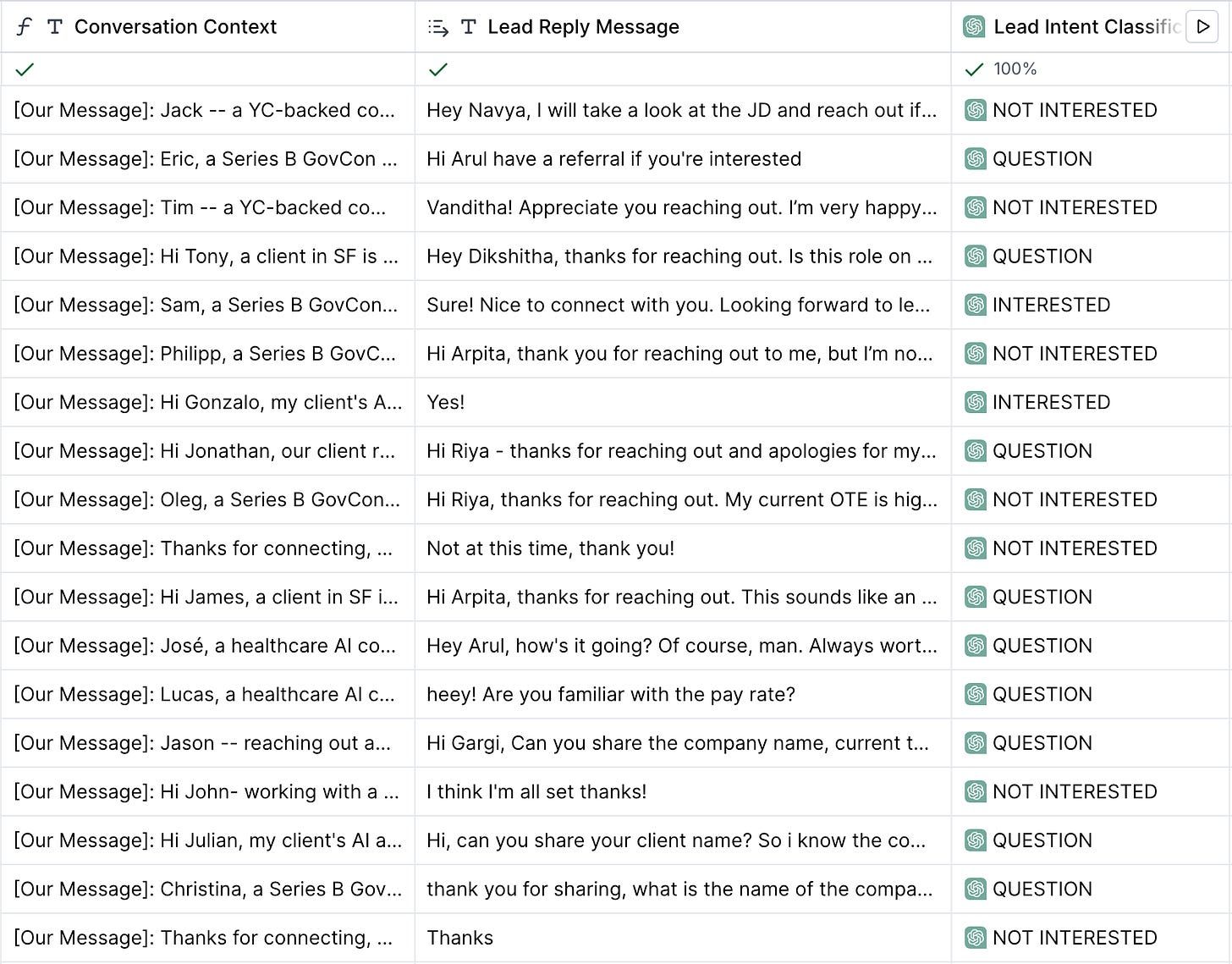
One of the best use cases of AI for recruiters is handling unstructured candidate data for grouping, classification, and intent.
For example, standardizing resumes with varying formats, grouping candidates based on ambiguous skill terms, or triaging messages for intent.
Anytime you notice the data you’re working with is more like language (resumes) than math (salaries), it’s a good indicator that AI could assist.
For example, recruiters get buried under 100s of messages from candidates every day, and AI can help triage them to determine whether someone is interested, not interested, or has a question, and then answer that question.
Store of memory
Recruiters have a lot of conversations, and it’s difficult to remember what was said.
AI is useful as a second brain, keeping track of key points, and more importantly, making new connections between conversations.
For example, AI can surface when a candidate we spoke with last month is the kind of person a hiring manager is looking for this month.
Additionally, to remind you of the motivations of an individual when they’re weighing up different job options, and your last conversation was a month ago.
Personalised messaging
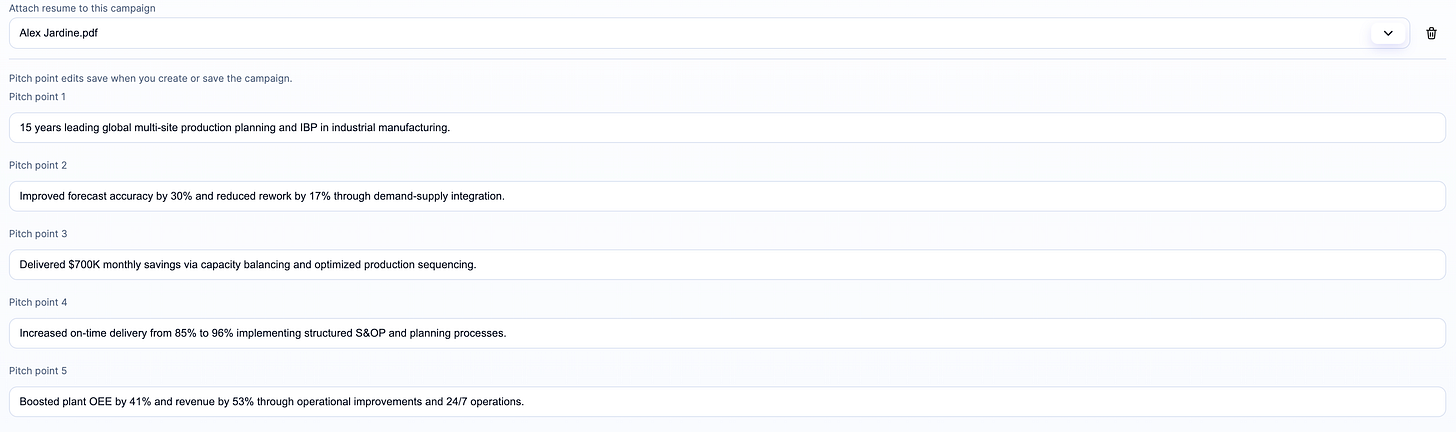
Instead of generic templates, AI can help recruiters get better responses from candidates and prospective clients by generating copy specific to an individual’s background.
For example, when marketing a candidate, AI can generate pitch points unique to that individual and the client’s needs based on the job description.
Looking ahead
Reflecting on our original thesis to scale a recruitment agency like a software company, I feel even more confident that recruiters are here to stay.
AI assists with the administrative parts of the business, but it’s best to leave decision-making to humans, where someone is accountable.
From building in the trenches and working with many other recruiters, it’s clear that the bigger issue has less to do with AI and more to do with how recruiters can scale client and candidate lead flow with systems instead of effort.
I’ve started working on that at recruitcha.ai, and will be posting more about my learnings as I go.